Documentary Journalism - TV
04/03/19

POST ONE
Modes of Documentary
In the past, I believed that documentary was a narrow, easily defined medium that offered very little in the way of creative expression. Once, I even thought that documentary filmmaking involved merely pointing a camera at something vaguely interesting and then clicking play and hoping for the best. I was wrong. I couldn’t have been more wrong. Documentaries are a hugely diverse medium, that offers creatives plenty of opportunities to express themselves artistically and challenge themselves narratively.
Most importantly, it’s an inclusive medium, and through the various ‘modes’ of documentaries, any filmmaker can find a niche within the practice. For the more artistically inclined, there is the ‘poetic mode’ which allows documentarians the opportunity to dispense with narrative convention and be more adventurous with their visual and audio style. Generally, this mode is all about experimentation. Completely counter to this is ‘observation mode,’ which requires a light touch by documentarians. Essentially, the mode requires a filmmaker to be a fly in the wall and doing very little to influence what’s happening in front of the camera. Basically, they have to point and shot, and allow their subject to tell the story.
With that being said, if a documentary on the whole, subscribes to a particular mode, it doesn't mean it can't possess stylistic or narrative elements that come from another. 'A film identified with a given mode need not be so entirely. The characteristics of a given mode function as a dominant in a given film: they give structure to the overall film, but they do not dictate or determine every aspect of its organization. Considerable latitude remains possible (B, Nicholls. Introduction to Documentary, 2001).' Essentially put, the modes should be seen as a flexible framework, intended to give filmmakers guidance rather than strict instructions. Documentary, similar artforms, thrives when creatives know their history, but aren't afraid to break the rules.
With that being said, if a documentary on the whole, subscribes to a particular mode, it doesn't mean it can't possess stylistic or narrative elements that come from another. 'A film identified with a given mode need not be so entirely. The characteristics of a given mode function as a dominant in a given film: they give structure to the overall film, but they do not dictate or determine every aspect of its organization. Considerable latitude remains possible (B, Nicholls. Introduction to Documentary, 2001).' Essentially put, the modes should be seen as a flexible framework, intended to give filmmakers guidance rather than strict instructions. Documentary, similar artforms, thrives when creatives know their history, but aren't afraid to break the rules.
My favourite mode is ‘reflective mode’, which requires a documentarian to be as involved in the filmmaking process in front of the camera as they are behind it. ‘Reflective’ is an almost meta approach to filmmaking as the documentarian is almost documenting themselves documenting somebody or something else. This mode also allows filmmakers to comment and speak honestly about the trials and tribulations of getting interviews and working within constraints. Pioneers of this art form are the likes of Nick Bloomfield and Louis Theroux, who almost put themselves at the centre of their documentaries, and their work becomes somewhat more about how they react to the stories they hear, rather than the actual stories themselves.
Louis Theroux - Altered States: Choosing Death

Louis Theroux - Altered States: Choosing Death
Gut-wrenching. Tear-jerking. Heartbreaking. Very rarely has a Louis Theroux documentary hit me on such a profound level. But, Choosing Death has done just that. Even right now, as I’m writing this, I’m still caught up in a whirl of emotion as its bittersweet truths still echo within my bones.
Usually, Theroux documentaries preoccupy themselves with the seedier, bizarre and unconventional pockets of humanity. However, with Choosing Death, Theroux peels back the surface of the human condition and looks at the layered and complex underneath. As well as this, to me, almost all of Theroux’s documentaries have seemed self-masturbatory, in the sense that while his documentaries may follow a whole roster of different and interesting people, ultimately, his documentaries are all about him - the star. Louis Theroux the world famous documentarian.
Yet, with Choosing Death, you get none of that. Instead, Theroux is genuine, attentive and allows himself to become a blank canvas to which other people can paint their stories onto. Choosing Death is not the Louis Theroux show – it’s the humanity show.
The only issue I had with the programme was its disregard of dissenting voices and more generally, people who morally opposed assisted suicide. Including such perspectives would have broadened the show and would have made it more intellectually stimulating and debate worthy. Also, one of the interviewees expressed the concern that allowing people to kill themselves and then brushing it under the carpet of freewill, smoulders debates over the lack of social care, general community disharmony and political oversight that allowed people to even consider suicide in the first place. However, disappointingly, Theroux only addressed this point through a brief conversation.
Leaving Neverland

Leaving Neverland was a harrowing watch that, at times, left me physically sick and repulsed. In gruesome and uncompromising detail, and via first-hand accounts, it chronicles the years of sexual abuse Micheal Jackson supposedly inflicted on Wade Robson and James Safechuck when they were just small boys. Now, as grown men, the pair explicitly reveal not only the details of the sex but also the emotional manipulation that came along with it.
Ultimately, the documentary concerns itself with exploring the cult of celebrity and the ways in which fame and money can help hoodwink justice. However, the documentary is complete and utterly one-sided and presumes wholeheartedly that Micheal Jackson is guilty. Thusly, it doesn't attempt to show an alternative side to the argument or even concern itself with impartiality.
Perhaps, this is due to the fact that the documentarian, Dan Reed, chooses to take on an observational approach to the material, i.e. acting as a mere fly on the wall as he allows Wade and James to retell their stories. However, I would wager that this lessened the impact of the documentary as it was so starved of balance.
However, disregarding balance, the film goes to great lengths to chart the emotional progression within Robinson and Safechuck, as we see them progress from being infatuated by Micheal and swept up in the magic of his celebrity and iconoclast status, to realise how perverted the whole situation was in retrospect.

Grizzly Man

POST TWO

Independent filmmaking
Recently we had the independent filmmaker, Aaron Sayers, who, purely from the sweat off his own back, was able to finance and produce his own film – Chosen Men.
Over the course of weeks and months, the documentary candidly explores the experiences of a group of army men, coming to terms with past traumas whilst also trying to reintegrate back into society, with great difficulty. Sure, the army taught them to be self-reliant killing machines, but it didn’t teach them how to be husbands, fathers and functioning members of society.
The inspiration behind the Chosen Men was born from Aaron’s own experiences in the army, which gave the documentary an added layer of authenticity. And in terms of the production process, Aaron was certain that being from an army background himself, allowed him access to veterans and their personal lives as he appeared less of a threat and less likely to exploit them.
Leaving Neverland
Leaving Neverland was a harrowing watch that, at times, left me physically sick and repulsed. In gruesome and uncompromising detail, and via first-hand accounts, it chronicles the years of sexual abuse Micheal Jackson supposedly inflicted on Wade Robson and James Safechuck when they were just small boys. Now, as grown men, the pair explicitly reveal not only the details of the sex but also the emotional manipulation that came along with it.
Ultimately, the documentary concerns itself with exploring the cult of celebrity and the ways in which fame and money can help hoodwink justice. However, the documentary is complete and utterly one-sided and presumes wholeheartedly that Micheal Jackson is guilty. Thusly, it doesn't attempt to show an alternative side to the argument or even concern itself with impartiality.
Perhaps, this is due to the fact that the documentarian, Dan Reed, chooses to take on an observational approach to the material, i.e. acting as a mere fly on the wall as he allows Wade and James to retell their stories. However, I would wager that this lessened the impact of the documentary as it was so starved of balance.
However, disregarding balance, the film goes to great lengths to chart the emotional progression within Robinson and Safechuck, as we see them progress from being infatuated by Micheal and swept up in the magic of his celebrity and iconoclast status, to realise how perverted the whole situation was in retrospect.
'Conflict alone doesn’t produce a story. For that to
happen, we need to have narrative development or progression. We have been
trained by years of movie and TV watching to assume that an action in one scene
will have an effect on the one that follows, and your audience wants to feel
like they’re moving forward rather than standing still (Bricca, J. Documentary Editing, 2017).'
In this regard, Leaving Neverland was a casebook example of effective filmmaking, as the film was concerned solely with shook tactics and trying to unease the audience, rather it was more concerned with exploring the effects on childhood trauma and the effects it can have on mental health in later life.
POST THREE
Music and Images
When it comes to creating effective and emotive visual work, the marriage between music and image is of utmost importance. The pair are two sides of the same coin. Together, music and image are like two dancers performing a delicate waltz; when they are in time and connected, the steps are seamless and fluid. However, when they are not… shambles. The steps fall out of sync and the dancers end up tripping over each other’s feet.
In class, we explored the ways in which clever and creative filmmakers, or documentarians, use music and image in tandem to create compelling work and hook the audience’s attention. Specifically, we looked at short films such as Splitscreen: A Love Story, Move, and Fifty People, One Question. Out of the pieces of work screened, I felt the former was most effective in its compelling use of music and image.
Mainly because the concept behind Splitscreen: A Love Story was simple and yet, compelling. Essentially, the short revolved around the idea of two lovers being divided by time, land and ocean. And yet, the days of these kindred spirits are so closely aligned that they could easily be interchangeable. With that being said, the filmmaker was able to effectively evoke this sense of ‘closeness’ by splitting the screen into two halves and splicing the two images back together again. Simultaneously ensuring the two images fitted together like two halves of the same picture. Meanwhile, the music was subtle, chirpy and the beat matched the editing cuts of the visuals, and vice versa.
It’s important to note, that music and images should be conceived with marriage in mind; one should not be able to exist or work without the other. I say this because too often do students or amateurs consider music to be an afterthought or a mere garnishing. When in truth, it’s the bedrock of any piece of effective visual work. For instance, if we peer into the canon of cinema, some of the greatest masterpieces of the art form have been the ones that have intertwined music into every word in the script. Films like Pulp Fiction (Quentin Tarantino, 1995) and American Graffiti (George Lucas, 1973) would be weightless without their soundtracks and music scores anchoring them down.
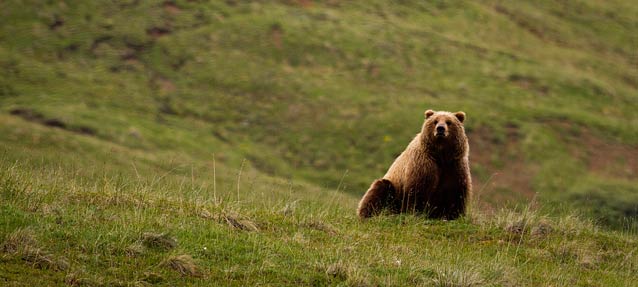
Grizzly Man
Grizzly Man provides a frank account of one man’s endearing and troubling relationship with bears – one of the most dangerous animals on planet earth. The documentary was equally amusing but saddening, as whilst Timothy Treadwell was charismatic and charming, from the gecko it’s made apparent that Treadwell was ultimately killed by the creatures he loved the most in the world.
The documentary was predominantly created using a voice over – director Werner Herzog, interviews from friends and family, and most importantly, self-shot footage from Treadwell himself. All in all, together they helped conjure up an intimate watch and the sense that you well and truly knew Treadwell, as if he was a long-lost friend.
Interestingly enough, straight from the gecko, Herzog makes it plain and obvious that Treadwell will become a victim of his own obsession – winning the love of these dangerous creatures. After which, all the footage of Treadwell undertakes a melancholy and poignancy because of it.
Often the question of why is asked. In my mind, perhaps, Treadwell was a man searching for love, and by winning the affection of these dangerous animals, in a way, shows that he is worthy of love. I came to this conclusion whilst watching and then reflecting back on a scene in which Treadwell speaks about his inability to maintain long and intimate relationships with women, or even win their affection in the first place. He even goes to claim that gay men – despite discrimination and
With that being said, the mode of documentary utilized is a mixture of participatory and observational. Which is to say, originally the documentary would have taken on a participatory approach as Treadwell would have been the documentarian, and he insisted on interacting with his subject matter. However, upon his death, the documentary became observational as Herzog opted to reflect on Treadwell using his own footage.
POST FOUR
Story structure
“The usual hero adventure begins with someone from whom something has been taken, or who feels there is something lacking in the normal experience available or permitted to the members of society. The person then takes off on a series of adventures beyond the ordinary, either to recover what has been lost or to discover some life-giving elixir. It's usually a cycle, a coming and a returning.”
Campbell, J. Man of a Thousand Faces, 1949.
The story helps give a documentary structure. Joseph Campbell’s Man of a Thousand Faces explored the fact that all stories across the world, regardless of time or culture, more or less consists of a similar structure. This discovery was monumental as it reinforces the idea that everyone in the world is connected, despite our differences in class, race and origin. At the same time, it underlined the fact the human experience is universal and ultimately, we all want the same things out of life – happiness, love and fulfilment.
Campbell also used his book to decipher and unpack this universal structure for his readers, in great detail. He called it The Hero’s Journey. Effectively, it spelt out the story components of all successful works of fiction and why they were needed in order to maintain audience attention and abide by the laws of storytelling. In total, Campbell identified 12 beats or segments of a story. He also drew heavily from the work of the Swiss Psychologist Carl Yung, and in particular, his pioneering research into analytical psychology – the ways in which people strive for wholeness and meaning.
Campbell also used his book to decipher and unpack this universal structure for his readers, in great detail. He called it The Hero’s Journey. Effectively, it spelt out the story components of all successful works of fiction and why they were needed in order to maintain audience attention and abide by the laws of storytelling. In total, Campbell identified 12 beats or segments of a story. He also drew heavily from the work of the Swiss Psychologist Carl Yung, and in particular, his pioneering research into analytical psychology – the ways in which people strive for wholeness and meaning.
What is at the heart of my story?


In class, we were given the task of creating a piece of documentary work that incorporated both music and visuals. For this task, rather than creating a mere slideshow of images,
I decided upon constructing a visual poem with a strong narrative element. My idea was to represent how two people could be infinitely different, yet still so connected.
The piece was called Black and White and represented how two kindred spirits choose to record memories. One deciding upon the immediacy and energy of a video, while the other preferred the intimacy and tenderness of a memento. To show this on screen, I recorded a series of different items on a table to represent the mementoes. Then I filmed at different landmarks around Bournemouth to represent the type of moments one of the lovers would have filmed on their phones. After which, I edited the two piece of footage together.
Due to the nature of the visual poem, I chose music that was light and tender. Ultimately, I wanted the music to give the visuals room to breathe and for it to not be overpowering. As well as this, I ensured that the editing was cut in time with the beats and tempo changes of the music. Considering that the film was called Black and White, and it was all about opposites attracting, in a literal interpretation, I made the film black and white to mirror the themes and title of the film.


Comments
Post a Comment